
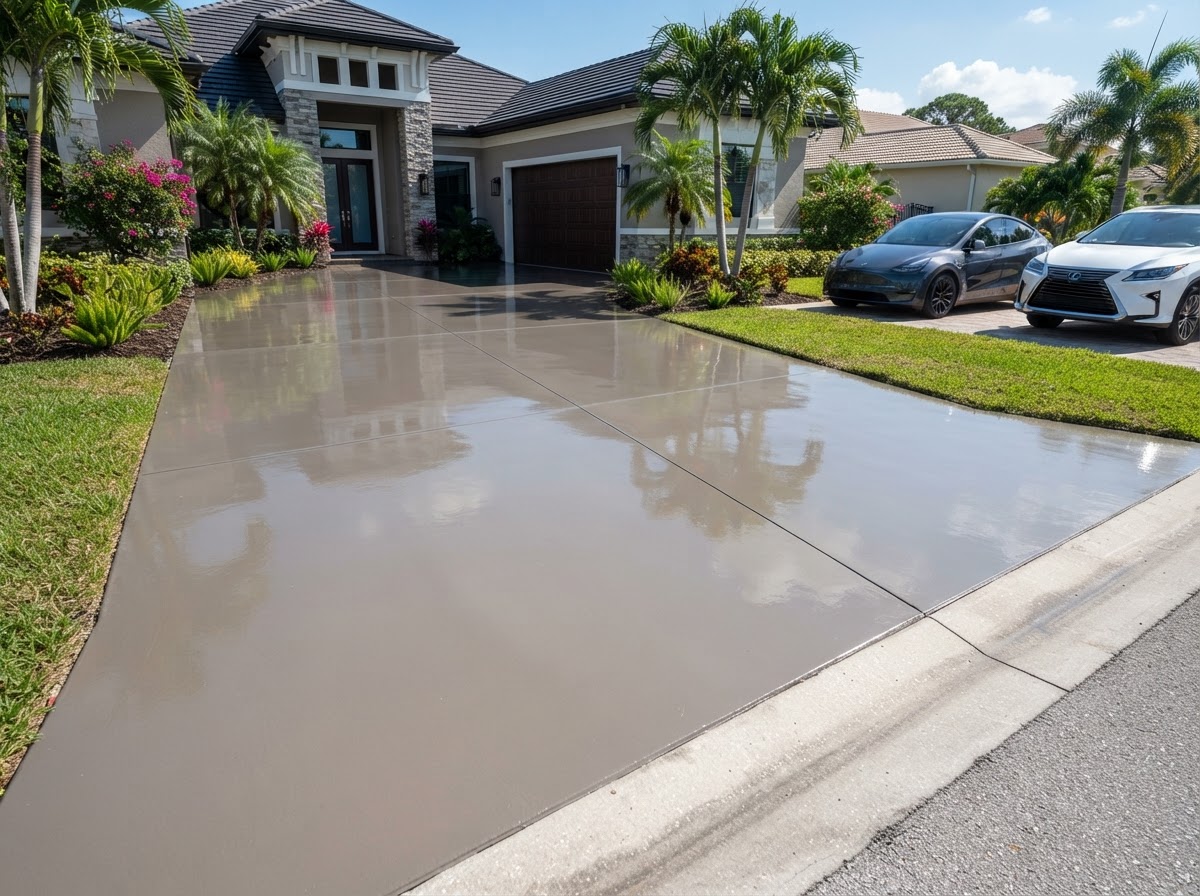
Driveway Coating Mistakes, Misconceptions, and How to Avoid Them
The common mistakes that undermine driveway coatings — from wrong topcoat to poor drainage — and how to prevent them before you install.
Driveway Coatings
2026-10-15
Driveway coating is specified for the exterior — and the mistakes that undermine it are almost always specification or preparation failures that leave the driveway chalked, faded, or peeling within a season. The wrong topcoat for the sun, the wrong color for the exposure, poor drainage, or skipped prep — each one is a mistake that turns a driveway coating into a driveway that fails in the South Florida sun. Understanding these mistakes is the best way to make sure your driveway coating stays finished.
KD Epoxy Floor installs driveway coatings across South Florida, from Palm Beach County to the Florida Keys. We've built our process to prevent every one of these failures. Here are the mistakes we see most often, the misconceptions behind them, and how to make sure your driveway coating doesn't fall victim to them.
Mistake 1: Using an interior epoxy on a driveway
A standard interior epoxy topcoat on a driveway will chalk, fade, and delaminate in the sun. The misconception is that epoxy is epoxy and the driveway just needs the same system as the garage. It doesn't — the driveway sees UV, rain, and thermal cycling that the garage floor never sees, and a non-UV-stable topcoat can't handle it. The mistake is using the wrong product for the exposure.
The fix is a UV-stable topcoat for every driveway — polyaspartic or UV-stable epoxy. See our garage epoxy flooring for the interior system, and note the difference: the garage can take a standard epoxy because it's sheltered; the driveway can't. The cost difference is the cost of a driveway that lasts, not one that chalks in a season.
Mistake 2: Choosing a dark color for full sun
A dark driveway coating in full South Florida sun absorbs heat — the surface gets hot underfoot and can show surface checking faster than a lighter color. The mistake is choosing the color by aesthetics alone, without considering how the sun will affect it. A dark driveway looks dramatic in the shade and shows every bit of dust in the sun.
The fix is balancing the look against the exposure. Lighter colors stay cooler and show less fading; darker colors are dramatic but hotter and dustier. We help you choose a color that looks good and performs well in the actual sun exposure — because a driveway that fades or checks in a season isn't a savings.
Mistake 3: Ignoring the drainage
A driveway coating that holds water is a driveway that's wet longer — and a wet driveway is a slip hazard and a coating that degrades faster. The mistake is coating the driveway without addressing the drainage, because the coating doesn't fix a drainage problem — it covers it up until the water undermines the coating.
The fix is assessing the drainage during the estimate. We look at how water moves on the surface, where it pools, and whether the drainage needs to be improved before the coating goes down. A driveway with good drainage dries fast and stays coated; one with poor drainage stays wet and fails the coating over time.
Common driveway coating mistakes
- Interior epoxy on exterior → use a UV-stable topcoat
- Dark color in full sun → balance look and exposure
- Ignoring drainage → assess and improve drainage first
- Coating over moisture → test and address first
- Skipping the prep → the system bonds to a prepared slab
- Rushing the cure → respect the cure window
Mistake 4: Coating over a failing slab
A driveway coating applied over a moist or oil-contaminated slab will blister and delaminate. The misconception is that the coating seals the slab and the contamination doesn't matter. It does — the bond is what makes the coating last, and moisture or oil compromises the bond. See our existing coating removal for the removal scope.
We test for moisture and test existing coating adhesion before any driveway coating goes down. If the slab has high moisture, we address it first. If the existing coating is failing, we remove it first. The driveway coating is only as durable as the slab it bonds to.
Mistake 5: Rushing the cure window
A driveway coating that's driven on before it's fully cured is a coating that gets damaged before it reaches its strength. The misconception is that the coating is done when it's dry to the touch. It isn't — dry to the touch is not full cure, and full cure is what gives the coating its resistance to tire heat and traffic. We tell you the exact timing for your system so you can plan around it.
How to make sure your driveway coating doesn't fail
Every mistake above is preventable with the right specification and process. We specify a UV-stable topcoat, match the color to the exposure, assess the drainage, test for moisture, prepare the slab, and respect the cure window. The estimate is where we identify what your driveway needs, and the installation is where we deliver it.
Share your city or ZIP and we'll confirm availability before scheduling the assessment. We serve South Florida from Palm Beach County to the Florida Keys, and we'll tell you honestly whether your area is within our working scope before we book the estimate.
Frequently asked questions
Why do driveway coatings fail?
Almost always because of specification or preparation failure — an interior epoxy used on an exterior surface, a dark color in full sun, poor drainage, moisture under the slab, or a failing existing coating coated over. The driveway coating is only as durable as the slab and the specification it's built on.
Can I use the same epoxy as my garage on my driveway?
No — a standard interior epoxy will chalk and fade in the sun. A driveway needs a UV-stable topcoat — polyaspartic or UV-stable epoxy — engineered for the exterior exposure. The garage is sheltered; the driveway isn't. See our garage epoxy flooring for the interior system.
What's the biggest mistake with driveway coatings?
Using an interior epoxy on an exterior driveway. The UV, rain, and thermal cycling break down a non-UV-stable topcoat in a season. We specify UV-stable systems for every driveway so the coating lasts for years.
Does drainage matter for a driveway coating?
Yes — a driveway that holds water is wet longer, which is a slip hazard and degrades the coating faster. We assess the drainage during the estimate and improve it if needed before the coating goes down.
Will my driveway coating fade?
A properly specified UV-stable system holds its color in the sun. A non-UV-stable topcoat chalks and fades. We specify UV-stable systems and set a maintenance schedule so a recoat refreshes the finish before fading becomes a problem.
Do you serve my area?
We serve South Florida from Palm Beach County to the Florida Keys. Share your project city or ZIP and we'll confirm availability before scheduling your estimate.
Want a driveway coating that lasts? Request a custom estimate and we'll specify it right.
More about Driveway Coatings
What Is Driveway Coating? Suitability and Common Questions
A clear guide to UV-stable driveway coatings — what they are, where they work, and the questions homeowners ask before coating an exterior concrete surface.
Driveway Coating Options, Comparisons, and Cost Factors
How UV-stable driveway coatings compare to bare concrete and interior epoxy — and what drives the cost of a protected, finished driveway.
Driveway Coating Preparation, Process, and Care
The step-by-step installation process for a driveway coating — from slab prep through UV-stable topcoat — plus the care routine that keeps it looking new.