
KD Epoxy Floor
Commercial & Warehouse Flooring in South Florida
KD Epoxy Floor installs commercial and warehouse flooring built for the loads South Florida businesses actually put on a floor — forklift traffic, pallet drag, chemical spills, and daily abuse. We specify heavy-duty epoxy and polyurethane systems rated for industrial use, with optional safety line striping for pedestrian aisles and hazard zones.
A commercial floor is only as good as its preparation and its product match to the traffic. We assess the slab, the chemical exposure, and the load before we recommend a system. We come to your property to assess the space and send a custom estimate — share your city or ZIP and we'll confirm availability.
Common applications
- Warehouses
- Distribution
- Manufacturing
- Retail backrooms
Key benefits
- Abrasion and impact resistance
- Chemical and oil resistance
- Optional safety line striping
- Long service life under load
What commercial and warehouse flooring includes
A commercial system is a high-build epoxy or polyurethane coating selected for the traffic and chemical exposure of the space. The slab is mechanically ground, joints are treated, and cracks are repaired before the build coats and topcoat go down. The topcoat is what takes the abuse — it is the wear surface.
For warehouses, that means a system rated for forklift point loads and pallet drag. For manufacturing, it means chemical resistance matched to what the floor will see. For retail backrooms, it means a durable, cleanable surface that does not need to be industrial-grade.
Who it is suitable for
Warehouses, distribution centers, manufacturing floors, and retail backrooms. Any commercial space where bare concrete dusts, stains, or fails under the traffic it gets.
We scale the system to the use. A distribution warehouse with forklifts gets a different system than a retail backroom with foot traffic, and we price and specify accordingly.
System options and how to choose
High-build epoxy delivers thickness and abrasion resistance for heavy traffic. A polyurethane topcoat adds UV stability and chemical resistance for exterior-loaded or chemical-exposed areas. Line striping organizes the floor for safety and compliance.
We match the system to the traffic level, chemical exposure, and square footage. Tell us what the floor will see and we specify the right build.
Commercial system options
- High-build epoxy — abrasion and impact resistance
- Polyurethane topcoat — UV and chemical resistance
- Safety line striping — aisles, lanes, hazard zones
- Joint treatment — flexible filler for moving joints
Preparation and what to expect
Mechanical grinding opens the surface, joint treatment and crack repair stabilize the slab, and moisture testing confirms the slab is ready to coat. Build coats and topcoat follow. For an operating facility, we plan the work in phases or off-hours to minimize downtime.
Expect a cure window before the floor takes full traffic. We give you the exact timing for the system and conditions so you can plan around it.
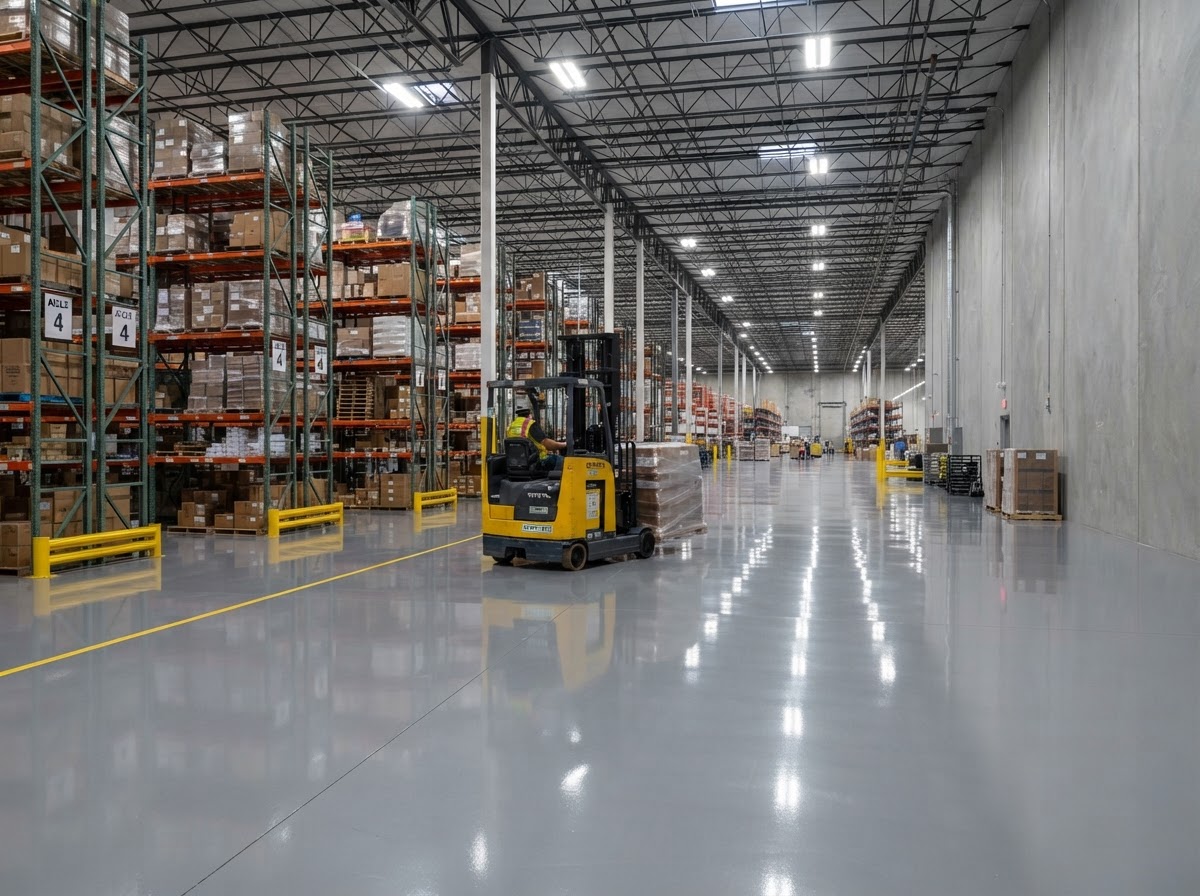
Safety line striping and layout
Line striping turns a coated floor into an organized, safe workspace. We stripe pedestrian aisles, forklift lanes, loading zones, and hazard areas so traffic flows clearly and compliance is visible. The striping is part of the coating system, not tape that peels, so it lasts as long as the floor does.
For South Florida warehouses operating in heat and humidity, a clearly striped floor also helps with forklift operator visibility and pedestrian separation — a practical safety investment, not just an aesthetic one.
Maintenance for a long service life
Sweep and scrub regularly, clean spills quickly, and inspect the topcoat for wear. A recoat on schedule extends the life of the floor and costs less than a full replacement. We can set a maintenance plan based on your traffic so the next intervention is planned, not reactive.
For a warehouse floor that takes forklift traffic daily, a recoat schedule is how you avoid the downtime and cost of a full replacement. We help you plan it around your operation.
Commercial flooring for South Florida businesses
South Florida businesses operate in heat and humidity that changes how a floor performs. A warehouse in Broward or a distribution center in Palm Beach County gets forklift traffic, pallet drag, and tracked sand that abrade a coating faster than the same traffic in a drier climate. We specify systems rated for that abuse and plan recoats around the traffic so the floor stays in service rather than failing between maintenance cycles.
For retail and light commercial spaces, a commercial coating does not have to read industrial. We scale the system to the use — a retail backroom gets a durable, cleanable surface, and a customer-facing space can carry a solid color or flake finish that looks finished while still taking foot traffic. The system is matched to the business, not the other way around.
Minimizing downtime during installation
For an operating facility, a floor coating is a logistics problem as much as a materials one. We plan installations in phases or off-hours so your operation keeps running while the floor is coated — nights, weekends, or section by section so traffic routes stay open. The goal is a coated floor without a stoppage that costs you production.
We coordinate with your schedule, your traffic patterns, and your cure-window constraints so the work happens when the floor can be out of service and the coating cures before traffic returns. That planning is part of the estimate, not an afterthought.
Choosing the right commercial system
A commercial floor is specified by the load, not the look. A forklift warehouse needs a high-build epoxy with a polyurethane topcoat for impact and chemical resistance. A retail backroom needs a durable, cleanable surface that does not have to take point loads. A manufacturing floor needs chemical resistance matched to what it actually spills. We assess the traffic and the exposure before we recommend a system, because the wrong specification is a floor that fails under the load it was supposed to handle.
Square footage, traffic level, and chemical exposure drive both the system and the price. We give you a custom estimate after assessing the slab and the use, not a flat per-square-foot number that ignores what the floor actually has to do.
How the process works
Mechanical grinding, joint treatment, and moisture testing for the slab.
- 01Assess traffic and chemical exposure
- 02Grind and prepare the slab
- 03Treat joints and cracks
- 04Install build coats and topcoat
Cost factors
- Traffic level
- Chemical exposure
- Square footage
- Line striping scope
Care & aftercare
- Sweep and scrub regularly
- Clean spills quickly
- Inspect topcoat for wear
Frequently asked questions
Yes. We plan installations to minimize downtime, including nights and weekends where appropriate, so your operation keeps running while the floor is coated.
Request commercial & warehouse flooring
Tell us about your project and we'll check whether we cover your exact address, walk you through finish options, and send a custom estimate. We come to your property — share your city or ZIP and we'll take it from there.