
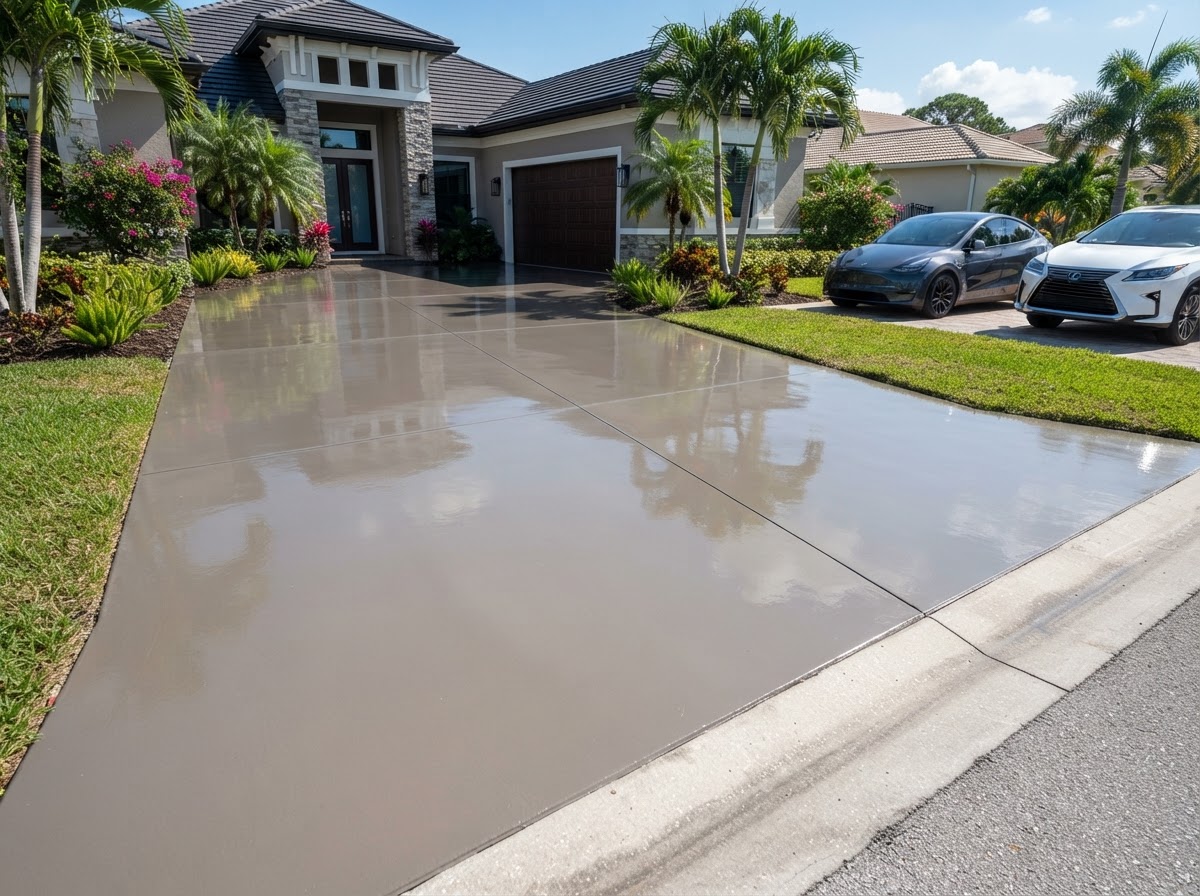
Driveway Coating Options, Comparisons, and Cost Factors
How UV-stable driveway coatings compare to bare concrete and interior epoxy — and what drives the cost of a protected, finished driveway.
Driveway Coatings
2026-10-15
Driveway coating offers a range of options — topcoat chemistry, color, finish, and traction — that change the look and the performance of the driveway. Understanding these options, and how a driveway coating compares to bare concrete and to interior epoxy, is the key to choosing a driveway that stays finished in the South Florida sun. We install the major driveway systems and can match the system to your actual exposure.
The cost of a driveway coating is driven by the same factors as any epoxy system — square footage, slab condition, the finish system, and any existing coating removal — plus the UV-stable topcoat specification. We give you a custom estimate after assessing the driveway, so the cost reflects what your surface actually needs. Here's how the options compare and what drives the price.
Polyaspartic versus UV-stable epoxy topcoats
Polyaspartic is the fast-cure option. A polyaspartic topcoat can accept traffic in hours, not days — which matters for a driveway that needs to be back in service fast. It also offers excellent UV stability and a bright, clear finish that holds its gloss in the sun. The trade-off is cost and the fast cure itself: the working time is short, so the installation has to be fast and precise, and the material costs more than a standard epoxy.
UV-stable epoxy is the proven option. A UV-stable epoxy topcoat offers good chemical resistance, a longer working time for a more controlled application, and a track record in exterior applications. It costs less than polyaspartic and cures over a day or more, which suits a driveway with downtime tolerance. The trade-off is the longer cure window before the driveway can take traffic.
Both are engineered for the sun. The choice between them is about the downtime tolerance and the budget, not about which is better — both hold up to the South Florida sun when specified correctly. We help you choose based on how fast you need the driveway back in service and what the budget allows.
Driveway topcoats at a glance
- Polyaspartic — fast cure, back in service in hours
- UV-stable epoxy — proven, longer cure, lower cost
- Both resist UV, tire heat, and oil
- Match the topcoat to downtime and budget
Driveway coating versus bare concrete
Bare concrete driveways stain, crack, and dust. Oil drips soak in, tire marks set, and the sun bakes the surface until it powders. A coated driveway resists all of it — the oil wipes clean, the tire heat doesn't soften the surface, and the UV doesn't chalk the color. The comparison is about protection: a bare driveway is a slab that deteriorates; a coated driveway is a surface that's protected.
The aesthetic difference is also significant. A bare concrete driveway reads as unfinished — a gray slab, stained and cracked. A coated driveway reads as finished — a uniform color or a textured flake finish that complements the home. For curb appeal, the coating is the difference between a driveway that looks maintained and one that looks neglected.
Driveway coating versus interior epoxy
Interior epoxy on a driveway is a common mistake. A standard interior epoxy topcoat isn't UV-stable — it will chalk, fade, and eventually delaminate in the sun. The misconception is that epoxy is epoxy and the driveway just needs the same system as the garage. It doesn't — the driveway sees UV, rain, and thermal cycling that the garage floor never sees, and the topcoat has to be specified for it.
We specify UV-stable systems for every driveway. See our garage epoxy flooring for the interior system, and note the difference: the garage floor can take a standard epoxy because it's sheltered; the driveway can't. The cost difference is the cost of a driveway coating that lasts, not one that chalks in a season.
What drives the cost of a driveway coating
Square footage is the base, with economies of scale on larger driveways. Slab condition and required repairs — cracks, spalls, and the joint preparation — are the variable that most often changes the scope. The topcoat chemistry — polyaspartic or UV-stable epoxy — affects the material and the labor. The color or flake finish affects the material. The aggregate, if added for traction, adds a small cost. Existing coating removal, if the old driveway has to come off, adds time and cost.
We assess all of this in person and include it in the estimate so there are no surprises. The estimate is custom because every driveway is different — a driveway with extensive cracking costs more to prepare than a clean slab, and a driveway with an existing coating costs more if it has to be removed first.
Cost factors for a driveway coating
- Square footage — the base, with economies of scale
- Slab condition — cracks, spalls, and joint repair
- Topcoat chemistry — polyaspartic or UV-stable epoxy
- Color or flake finish — solid color or textured flake
- Anti-slip aggregate — if added for wet traction
- Existing coating removal — if the old driveway has to come off
How to choose without overpaying
The right driveway system is the one that matches your exposure and your downtime tolerance. A driveway that needs to be back in service fast may warrant polyaspartic; one with downtime tolerance may be fine with UV-stable epoxy. We help you match the system to the real use so you pay for the performance you need, not for chemistry you don't.
Share your city or ZIP and we'll confirm availability and schedule the assessment. The estimate is where we identify what your driveway needs and what it doesn't — so the cost reflects the actual scope, not a generic number that ignores the slab.
Frequently asked questions
Is driveway coating more expensive than interior epoxy?
Yes, typically — the UV-stable topcoat costs more than a standard interior epoxy because it's engineered for the sun. The trade-off is performance: an interior epoxy on a driveway will chalk and fade in a season, while a UV-stable system lasts for years. The cost difference is the cost of a driveway that stays finished.
Polyaspartic or UV-stable epoxy for my driveway?
It depends on downtime and budget. Polyaspartic cures in hours and gets the driveway back in service fast; UV-stable epoxy costs less and cures over a day or more. Both hold up to the sun when specified correctly. We help you choose based on your needs.
Can I match the driveway to my home's color?
Yes — we offer solid colors and flake finishes in a range of options. The color is your choice, independent of the website's interface colors. We help you coordinate the driveway color with the home and the exposure.
What affects the price of a driveway coating?
Square footage, slab condition, topcoat chemistry, color or flake finish, anti-slip aggregate, and any existing coating removal. We assess all of these in person and include them in the custom estimate so the cost reflects the actual scope.
Do I need anti-slip aggregate on a driveway?
For a South Florida driveway that sees rain, it's often worth it. A smooth coating can be slick when wet; the aggregate adds grip without changing the color. We can add it to the topcoat if the driveway's drainage or slope makes it slippery.
Do you serve my area?
We serve South Florida from Palm Beach County to the Florida Keys. Share your project city or ZIP and we'll confirm availability before scheduling your estimate.
Ready to compare driveway coating options? Request a custom estimate and we'll match the system to your driveway.
More about Driveway Coatings
What Is Driveway Coating? Suitability and Common Questions
A clear guide to UV-stable driveway coatings — what they are, where they work, and the questions homeowners ask before coating an exterior concrete surface.
Driveway Coating Preparation, Process, and Care
The step-by-step installation process for a driveway coating — from slab prep through UV-stable topcoat — plus the care routine that keeps it looking new.
Driveway Coating Mistakes, Misconceptions, and How to Avoid Them
The common mistakes that undermine driveway coatings — from wrong topcoat to poor drainage — and how to prevent them before you install.