
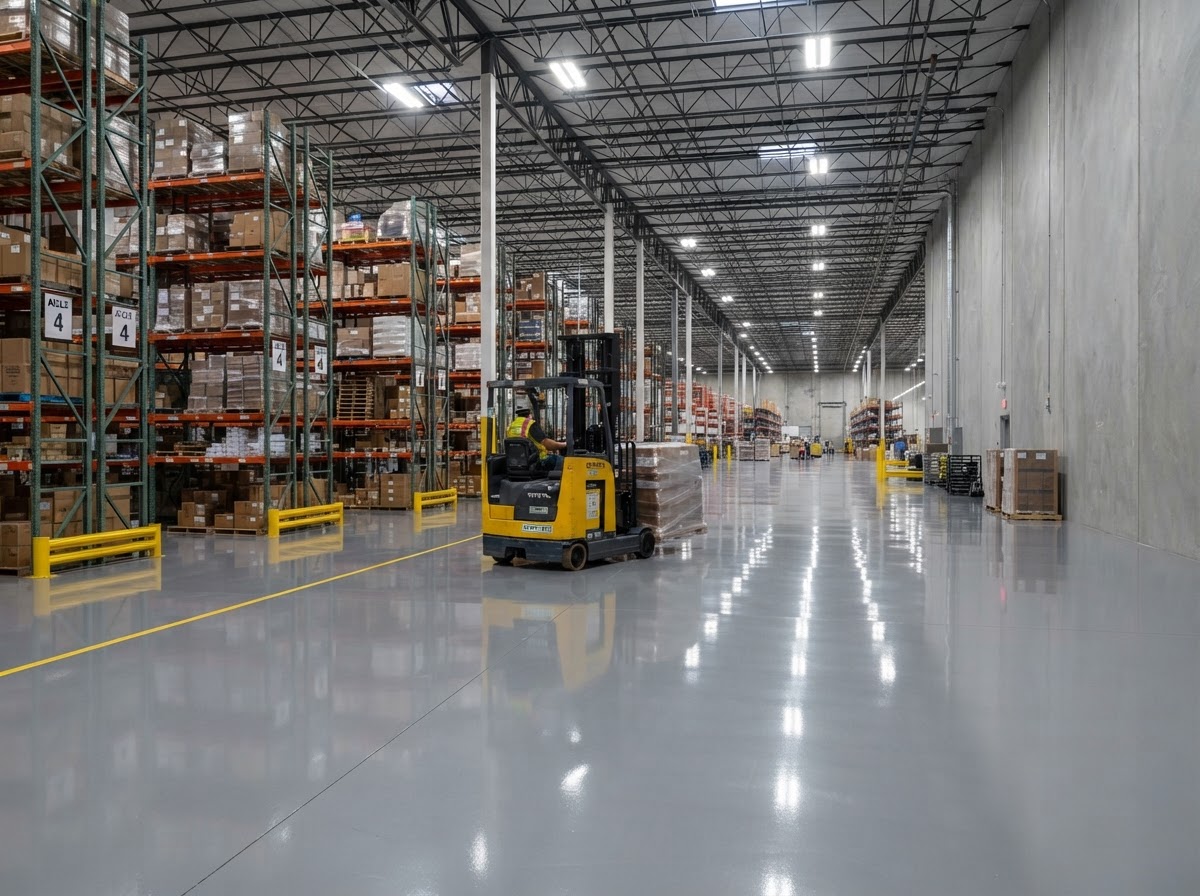
What Is Commercial & Warehouse Flooring? Suitability and Common Questions
A clear guide to heavy-duty commercial and warehouse epoxy flooring — what it is, where it's required, and the questions facility managers ask before coating a working floor.
Commercial & Warehouse Flooring
2026-10-15
Commercial and warehouse flooring is a heavy-duty epoxy or polyurethane coating system engineered for the abuse a working floor takes: forklift traffic, pallet drag, chemical spills, thermal cycling, and constant foot traffic. Unlike residential epoxy, which is chosen mostly for appearance, commercial flooring is chosen for performance — the coating has to hold up to the traffic the space actually sees, not just look good on day one. It's the system we install in warehouses, manufacturing floors, retail back-of-house, auto shops, and any commercial space where a bare or failing concrete floor costs the business time and money.
KD Epoxy Floor installs commercial and warehouse flooring from Palm Beach County to the Florida Keys. We come to your facility to assess the slab, the traffic, and the chemical and thermal exposure, and we send a custom estimate based on the actual conditions. Share your city or ZIP and we'll confirm availability before scheduling the assessment.
What commercial and warehouse flooring actually is
A commercial floor is built for traffic. The slab is ground and profiled for adhesion, joints and cracks are repaired and sometimes sealed, and a heavy-duty basecoat is applied. The build coats add the thickness and the wear resistance the traffic demands, and a topcoat — epoxy, polyurethane, or polyaspartic — seals the system and provides the chemical and abrasion resistance. The result is a seamless, dense surface that takes the abuse a working floor dishes out.
The difference from residential epoxy is the build. A residential garage floor sees passenger vehicles and foot traffic; a warehouse floor sees forklifts, pallet jacks, and constant heavy loads. The coating has to be thicker, denser, and more abrasion-resistant to hold up. A residential system in a warehouse will fail in months; a commercial system is engineered for the traffic it will actually see.
The system is seamless — no grout lines, no tile joints to trap debris — which matters in a commercial space where sanitation and cleanability are part of the floor's job. The topcoat can be tuned for chemical resistance, for thermal cycling, and for traction. Optional safety line striping — walkways, forklift lanes, hazard zones — turns the floor into a traffic management tool, not just a surface.
Who commercial and warehouse flooring is suitable for
Commercial flooring suits any space where the floor is a working surface. Warehouses and distribution centers are the classic application — forklift traffic, pallet drag, and constant heavy loads demand a coating engineered for the abuse. Manufacturing floors, auto shops, and machine shops need chemical resistance and abrasion resistance that bare concrete can't deliver. Retail back-of-house, commercial kitchens, and any space where sanitation matters benefit from a seamless, cleanable surface.
In South Florida, the climate adds another layer. Humidity and temperature swings affect concrete, and a bare warehouse floor dusts in that environment — coating everything stored on it with a fine powder. A sealed commercial floor stops the dusting, resists the humidity, and wipes clean of the sand and moisture that get tracked in. For a business that stores inventory or serves customers, a dusting floor is a cost; a sealed floor is an investment.
The traffic determines the system. A light-traffic retail floor needs less build than a heavy-traffic warehouse. A chemical-exposure auto shop needs a different topcoat than a dry-goods warehouse. We assess the actual traffic and exposure and match the system to the use — because a commercial floor that's under-specified fails, and one that's over-specified costs more than it needs to.
Common questions about commercial flooring
The most common question is how long the floor lasts. A properly specified and installed commercial system, with the right build for the traffic and the right topcoat for the exposure, can last for years before it needs a recoat. The lifespan depends on the traffic, the maintenance, and whether the system was matched to the use — which is why the assessment matters. We tell you the expected lifespan for your specific application after the assessment.
Another frequent question is about downtime. Commercial floors can't be out of service for long without costing the business. We plan the installation around your schedule — nights, weekends, phased sections — so the floor is back in service as fast as possible. The cure window affects the timeline: some systems accept traffic faster than others, and we match the product to your downtime tolerance.
Facility managers also ask about chemical resistance. The topcoat determines the chemical resistance — epoxy, polyurethane, and polyaspartic each have different resistance profiles. For a floor that sees oil, solvents, acids, or cleaning chemicals, we specify a topcoat that holds up to the actual exposure. We assess the chemicals your floor will see and match the topcoat to them.
What to know about commercial flooring
- Engineered for traffic — forklifts, pallets, heavy loads
- Seamless and cleanable — no grout lines to trap debris
- Chemical and abrasion resistance tuned to the exposure
- Optional safety line striping for traffic management
- Downtime planned around your schedule
Choosing the right commercial system
The system is specified by the traffic and the exposure. A heavy-duty epoxy build with a polyurethane topcoat suits most warehouse and manufacturing applications — the build handles the abrasion, the topcoat handles the chemicals. A polyaspartic system, with faster cure, suits applications where downtime is critical. We match the system to the actual use, not to a generic commercial spec.
The topcoat is the wear surface, and it's where the chemical resistance lives. For a dry warehouse, a standard topcoat may suffice. For an auto shop or a manufacturing floor with chemical exposure, a higher-grade topcoat is specified. For a commercial kitchen or a food-processing floor, a sanitary topcoat with cove base integration may be required. See our sanitary cove base installation for the cove base scope.
What to expect from the estimate
We come to your facility to assess the slab, the traffic, the chemical and thermal exposure, and any existing coating that needs removal. The estimate includes the system build, the topcoat specification, any joint and crack repair, any existing coating removal, and optional line striping — so the cost reflects the actual scope, not a generic per-square-foot number.
Share your project city or ZIP and we'll confirm availability before scheduling. We serve South Florida from Palm Beach County to the Florida Keys, and we'll tell you honestly whether your area is within our working scope before we book the assessment.
Frequently asked questions
What is commercial and warehouse flooring?
It's a heavy-duty epoxy or polyurethane coating system engineered for the traffic, chemical exposure, and abrasion a working floor takes. Unlike residential epoxy, it's specified by performance — the coating has to hold up to forklifts, pallets, chemicals, and constant use, not just look good on day one.
How long does a commercial floor last?
A properly specified and installed system, matched to the traffic and exposure, can last for years before a recoat. The lifespan depends on the traffic, the maintenance, and whether the system was matched to the use. We tell you the expected lifespan for your specific application after the assessment.
How much downtime will the installation require?
We plan the installation around your schedule — nights, weekends, or phased sections — so the floor is back in service as fast as possible. The cure window affects the timeline, and we match the product to your downtime tolerance. Some systems accept traffic faster than others.
Can the floor handle chemical spills?
The topcoat determines the chemical resistance. We assess the chemicals your floor will see — oil, solvents, acids, cleaning chemicals — and specify a topcoat that holds up to the actual exposure. A floor that's under-specified for its chemicals will fail at the surface.
Do you offer safety line striping?
Yes — we can add walkway lines, forklift lanes, hazard zones, and safety striping to turn the floor into a traffic management tool. Line striping is part of the commercial system, not a separate add-on, and we include it in the estimate when it's relevant to your space.
Do you serve my area?
We serve South Florida from Palm Beach County to the Florida Keys. Share your project city or ZIP and we'll confirm availability before scheduling your estimate.
Need a commercial floor that holds up? Request a custom estimate and we'll assess your facility.
More about Commercial & Warehouse Flooring
Commercial Flooring Options, Comparisons, and Cost Factors
How epoxy, polyurethane, and polyaspartic commercial systems compare — and what drives the cost of a heavy-duty working floor.
Commercial Flooring Preparation, Process, and Care
The step-by-step installation process for a commercial epoxy floor — from slab prep through topcoat — plus the maintenance that keeps it in service.
Commercial Flooring Mistakes, Misconceptions, and How to Avoid Them
The common mistakes that undermine commercial and warehouse floors — from under-specification to poor joint prep — and how to prevent them.