
Metallic Epoxy Mistakes, Misconceptions, and How to Avoid Them
The common mistakes that undermine metallic epoxy floors — from wrong slab prep to rushed effect — and how to prevent them before you install.
Metallic Epoxy Flooring
2026-10-15
Metallic epoxy flooring is the showpiece finish — dimensional, one-of-a-kind, and dramatic. But that dimension is also its vulnerability. Because a metallic floor shows the slab's condition plainly and the effect is hand-manipulated, every mistake in preparation, every flaw in the slab, and every error in manipulation shows through the finish. The mistakes that undermine a metallic floor are the same as any epoxy system — skipped prep, unrepaired cracks, ignored moisture — plus the metallic-specific errors of insufficient slab refinement or rushed effect. Understanding these mistakes is the best way to avoid them.
KD Epoxy Floor installs metallic epoxy flooring across South Florida, from Palm Beach County to the Florida Keys. We've built our process to prevent every one of these failures. Here are the mistakes we see most often, the misconceptions behind them, and how to make sure your metallic floor doesn't fall victim to them.
Mistake 1: Insufficient slab refinement
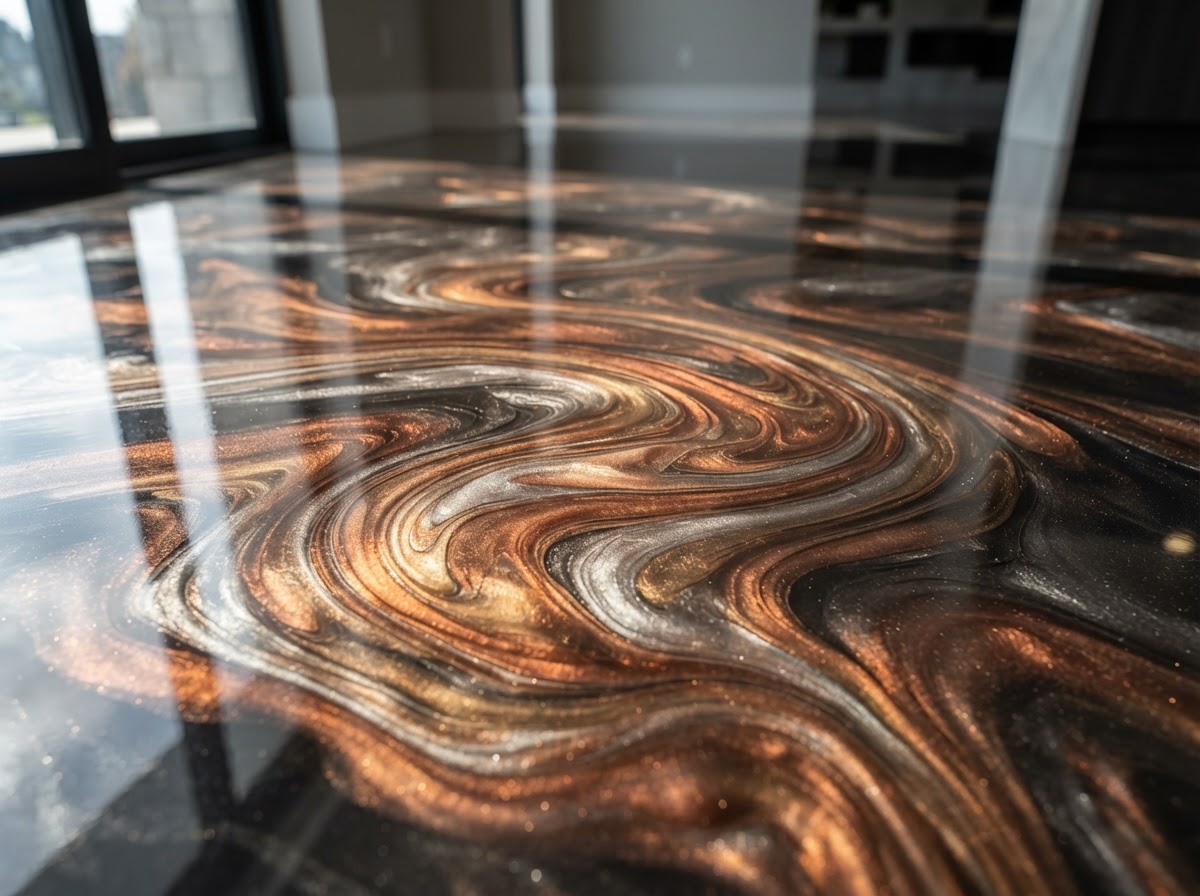
A metallic floor shows the slab's texture plainly — more than flake, comparable to solid color. If the slab isn't refined enough, the dimensional effect reads the texture as bumps and waves through the movement, and the floor looks rough instead of polished. The mistake is prepping the slab to a flake standard when metallic demands a smoother surface — because the metallic effect amplifies what the prep leaves.
The fix is refined preparation. We diamond-grind to a smoother profile for metallic than for flake, and we level the repairs to the surrounding slab so the effect reads as continuous. The prep is what makes a metallic floor look like a showpiece; the finish only shows what the prep leaves.
Mistake 2: Rushing the metallic manipulation
The metallic effect is hand-manipulated while the resin is wet. If the manipulation is rushed — rolled flat without working the pigments, or stopped before the effect settles — the floor reads as flat, not dimensional. The mistake is treating the metallic coat like a standard color coat, rolling it on and walking away. The metallic effect requires time and technique to create the movement that makes it a showpiece.
The fix is experience and patience. We work the pigments with rollers and tools to create the flowing, dimensional effect, tuning the movement to the look you want. The manipulation is the most labor-intensive step, and it's what makes every metallic floor one-of-a-kind — and what makes a rushed metallic floor look flat instead of dimensional.
Mistake 3: Coating over moisture or a failing slab
A metallic floor applied over a moist slab can blister and delaminate as moisture vapor pushes through the surface. A metallic floor applied over a failing existing coating lifts with the old coating underneath it. The misconception is that the metallic system is thick enough to bridge these problems. It isn't — no coating system bonds to a compromised substrate, and on a dimensional surface, the failure is more visible.
We test for moisture and test existing coating adhesion before any metallic goes down. If the slab has high moisture, we address it first. If the existing coating is failing, we remove it first. See our existing coating removal for the removal scope. The metallic system is only as durable as the slab it bonds to.
Common metallic epoxy mistakes
- Insufficient slab refinement → grind smoother for metallic
- Rushed manipulation → work the pigments for the effect
- Coating over moisture → test and address first
- Coating over failure → test adhesion, remove if failing
- Wrong sheen for the use → match gloss to maintenance
- Rushing the cure → respect the cure window
Mistake 4: Choosing high-gloss for a high-traffic space
High-gloss amplifies the dimensional effect — it's the most dramatic sheen — but it also shows every scuff and every dust mark. In a high-traffic space, a high-gloss metallic floor looks worn within weeks because every mark is visible against the reflective, dimensional surface. The mistake is choosing the sheen based on the showpiece look without considering the maintenance it demands.
The fix is matching the sheen to the traffic. For a feature room that stays clean, high-gloss delivers the full showpiece. For a premium garage that gets daily use, satin softens the effect and hides the wear. We help you choose the sheen based on the use and the maintenance you're willing to give it.
Mistake 5: Unrefined crack repair
On a flake floor, the texture camouflages a repair that's not perfectly flush. On a metallic floor, the dimensional surface shows every repair that's raised or recessed as a line or patch through the movement. The mistake is repairing cracks to a standard that suits a textured floor but not a dimensional one — because the metallic effect reads the repair as a visible disruption if it's not leveled.
The fix is refined repair. We level the repair to the surrounding slab so the metallic effect reads as continuous. See our concrete crack and hole repair for the repair scope. The prep is what makes a metallic floor look like a showpiece; the finish only shows what the prep leaves.
Mistake 6: Rushing the cure window
A metallic floor that's walked on, driven on, or loaded before it's fully cured is a floor that gets damaged before it reaches its strength. The misconception is that the floor is done when the topcoat is dry to the touch. It isn't — dry to the touch is not full cure, and full cure is what gives the floor its resistance to traffic and chemicals.
Pedestrian traffic is usually fine within 24 hours, but full cure takes longer — typically three to seven days depending on the product and conditions. We tell you the exact timing for your system so you can plan around it. Rushing the cure is how a metallic floor that should last years gets damaged in the first week.
How to make sure your metallic floor doesn't fail
Every mistake above is preventable with the right process. We refine the slab, repair every crack to a flush standard, test for moisture, work the metallic pigments for the effect, match the sheen to the use, and respect the cure window — because each step is what makes the metallic floor a showpiece that lasts. The estimate is where we identify what your floor needs, and the installation is where we deliver it.
Share your city or ZIP and we'll confirm availability before scheduling the assessment. We serve South Florida from Palm Beach County to the Florida Keys, and we'll tell you honestly whether your area is within our working scope before we book the estimate.
Frequently asked questions
Why do metallic epoxy floors peel?
Almost always because of preparation failure — the slab wasn't ground or refined, the crack wasn't repaired, moisture wasn't tested, or a failing existing coating was coated over. The metallic system bonds to the slab, and if the slab is compromised, the effect goes with it.
Can I install metallic epoxy myself?
DIY metallic kits are available, but they skip the slab refinement that makes the effect read as smooth and the technique that makes the manipulation dimensional. Without refined prep and hand-manipulation, a DIY metallic floor looks flat and lifts. The cost of professional installation is the cost of a showpiece that lasts.
What's the biggest mistake with metallic epoxy?
Insufficient slab refinement. Metallic shows the slab's texture plainly, so a slab prepped to a flake standard reads as rough through the dimensional effect. We refine the prep for metallic so the effect reads as smooth and polished.
Why does my metallic floor look flat?
The metallic effect was likely rushed — rolled flat without working the pigments. The dimensional movement requires hand-manipulation while the resin is wet. A rushed metallic coat reads as a flat color coat, not a showpiece. We work the pigments for the full effect.
Will the metallic effect fade?
We use UV-stable pigments and topcoats for exterior or sun-exposed areas. For interior applications, fading is not a concern. For full-sun spaces, we confirm the right UV-stable product for the exposure, and a recoat on schedule restores the finish before fading becomes a problem.
Do you serve my area?
We serve South Florida from Palm Beach County to the Florida Keys. Share your project city or ZIP and we'll confirm availability before scheduling your estimate.
Want a metallic floor that lasts? Request a custom estimate and we'll do the preparation right.
More about Metallic Epoxy Flooring
What Is Metallic Epoxy Flooring? Suitability and Common Questions
A clear guide to metallic epoxy — what it is, where it works best, and the questions homeowners ask before choosing a dimensional, showpiece floor.
Metallic Epoxy Options, Comparisons, and Cost Factors
How metallic epoxy color and effect options compare to solid color and flake — and what drives the cost of a dimensional showpiece floor.
Metallic Epoxy Preparation, Process, and Care
The step-by-step installation process for a metallic epoxy floor — from slab prep through topcoat — plus the care routine that keeps it looking new.